Homeschool World Practical Homeschooling
PHS ColumnistsTop Menu
Mary Pride

Carole Adams

Ray Andree

Karen Andreola

Frank Armbruster

David Ayers

Larry Bailey

Johanna Banham

Lisa and Rhonda Barfield

Peggy Barker

Jonathan Bechtle

Russ Beck

Alisyn Bennett

Vicki Bentley

Betty Berring

Mary Biever

George Bigham

Harvey and Laurie Bluedorn

Sam Blumenfeld

Lydia Guy Burchett

Charles and Betty Burger

Linda Burklin

Wes Callihan

Holly Capeda

Heather Chapman

Clay and Sally Clarkson

Marion Kester Coombs

Deborah Copelin

Cheryl Costello

Martin Cothran

Jim Couch

Lorraine Curry

Michelle Dalrymple

Chris Davis

Ellyn Davis

Kandie Demarest

Joan Donaldson

Richard Driggers

Cathy Duffy

Jonathan English

Carolyn Flanagan

Samuel Francis

Amanda Freitag

Marshall Fritz

Lisa Gard

John Taylor Gatto

Brittany Glenny

Tricia Goyer

Pat Graves

Steve Hake

Ken Ham

Kristin Lee Hamerski

Gregg Harris

Joshua Harris

Laura Harris

Lori Harris

Bob Hazen

Barbara Henderson

Sarah Hensley

Laura Hinely

Fritz Hinrichs

Regina Hogsten

Jessica Hulcy

D. Russel Humphries

Nicole Johnson

Elizabeth Kays

Diane Flynn Keith

Stephen Kemp

Rebecca Kenney

Andrew Kern

Chris Klicka

Jim Kramer

Lenora Levia

Ann Lloyd

Isabel Lyman

Christina Magnaghi

Michael Maloney

Jason Makansi

Paula Mann

David Marks

Rodney Marshall

Shelly Mathiot

Renee Mathis

Pam Maxey

Theresa May

Kristen West McGuire

Geneva Miller

Katie Michelli

Melissa Morgan

Sarah Morgan

Gretchen Mork

Natalie Muus

Edwin Myers

Naomi Nattress

John Nixdorf

June Oberlander

Joy Pavelski

Mary Pecci

Dennis Peterson

Nikki Pheneger

Michael Platt

Drue Porter

Bill Pride

Franklin Pride

Joseph Pride

Madeleine Pride

Magda Pride

Sarah Pride

Bob Reith

Michael Reitz

Howard and Sue Richman

Elizabeth Roberts

Dr. Arthur Robinson

Penny Ross

Teresa Schultz-Jones

Rebecca Sealfon

Rob and Cyndy Shearer

Scott Somerville

Bruce Shortt

Gail Small

Barry Stebbing

Andrew Stone

Alexandra Swann

Benjamin Swann

Joyce Swann

Janis Tatum

Jennifer Thieme

Heather Thompson

Christopher Thorne

Rita Tubbs

Dale Turner

Jamie Turner

Maryann Turner

Janice VanCleave

Brad Voeller

Kathy von Duyke

Steve Wagner

Eric Wallace

Austin Webb

Jeannette Webb

Natalie Webb

Pat Wesolowski

Adam Wickwire

Peter Williams

Douglas Wilson

Kym Wright

Lisa Yoder

Vivian Young

Other

Walk Like a Bug

By Janice VanCleave
Printed in Practical Homeschooling #66, 2005.


Fun Time

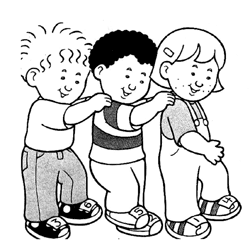
As a bug walks, three legs support the weight of the body while the other three legs swing forward to a new position. To walk like a grasshopper, ant, or ladybug try this:

Form a line with two helpers, one behind the other. Place your hands on each other's shoulders.

Adult step. Write the numbers 1 through 6 on the labels. Place the labels on the children's shoes as shown.

Adult step. Instruct the children to walk using the feet that you tell them to lift.

  1. First lift and move forward feet 1, 3, and 5.

  2. Next, lift and move forward feet 2, 4, and 6.

  3. Repeat the steps several times.

This experiment was taken from Janice VanCleave's Play and Find Out About Bugs and used by permission of the publisher, John Wiley & Sons, Inc.

For more information about insects, check out Janice VanCleave's Insects (ages 8-12) and Janice VanCleave's A+ Projects in Biology (ages 13 and up).

Q: With six feet, why don't bugs step on their own feet?

A: Bugs with six legs balance on just three of their legs, if they are the correct ones. The three legs that they must keep on the ground are the front and hind legs on one side plus the middle leg on the opposite side. They can raise the three other legs to walk. So, they have room to move their legs and walk without stepping on their own feet.

The term "bug" is often loosely used to mean any small creepy crawler. Bugs belong to a group of animals called arthropods. Arthropods makeup more than three-fourths of all kinds of animals and include such familiar bugs as insects, spiders, centipedes, and millipedes. These bugs are different in many ways, including the number of their legs. Insects have six legs and spiders have eight. While the name centipede means 100 feet, these bugs can have many more than 100 feet but most have fewer than 50. While some centipedes do have 100 feet, no millipedes have 1,000 feet as their name implies.

Bugs on land move from place to place by walking on legs. The fewer and longer the legs are, the harder it is for the animal to balance. Spiders stand on four legs at a time, two on each side (first and second on one side and second and fourth on the other side). The other four legs do not all move together. Instead they move in a wavelike motion, with the first leg coming down about the time the fourth leg is being lifted. A general principal of walking for animals with four or more legs is that alternate legs are lifted and no leg is moved until the one behind it is in supporting position.

| Share

Comment on this article Visit our forum

| Share
Was this article helpful to you? Subscribe to Practical Homeschooling today, and you'll get this quality of information and encouragement five times per year, delivered to your door. To start, click on the link below that describes you:

USA Individual
USA Librarian (purchasing for a library)
Outside USA Individual
Outside USA Library

Terms of Use  •  Privacy Policy  •  Copyright ©1993-2012 Home Life, Inc.