 One of the reasons why children have so many spelling problems is because of their shaky knowledge of how to spell many of our long-vowel words. The big problem with long vowels is that there is more than one way to spell the same sound. For example, long a can be spelled simply a as in apron, agent or April; or a-consonant-e, as in ate, page, or fame; or ai as in rain, waif, or maid; or ay as in day, gray, or play; or ei as in vein or rein; or eigh, as in eight or weight. Notice that in ei and eigh, there is not an a in sight.
And that is why in my own phonics program I deliberately left the learning of the long vowel spelling forms to the last part of the instruction. I believe the child should first be taught the short vowels and consonants, the consonant blends, and finally the long vowels. Because the learner has become competent with the short vowels, consonants, and consonant blends, he or she can now concentrate on mastering the long-vowel spelling forms.
There is more to phonics than merely learning to spell words phonetically. That's the way words were spelled before the advent of dictionaries. If you read documents written during the Elizabethan era, you will see the variety of spellings that the writers used. Words back then were written in a variety of phonetic spellings. The dictionary established correct or final acceptable spellings.
That is why spelling bees can be so difficult. They insist on correct spellings, not merely phonetic spellings.
Parents often ask me how to help their children improve their spelling. I tell them to have the child copy correctly spelled text, an article or essay on a subject of interest to the child. Good texts can be found in publications like the Reader's Digest or in encyclopedias. Constant copying of correct spelling produces good spellers.
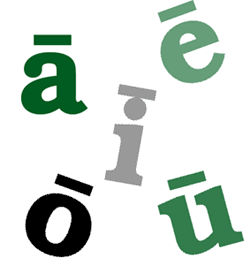 Long e, like long a, has its variety of spelling forms. There is simple e as in ego, E-Bay, or Eton; double ee as in feet, feed, and feel; ea as in meat, mean, and meal; ie as in field, yield, and shield; e-consonant-e as in eve and Steve; y as in many and funny; ey as in key, monkey, and valley.
We find the same variety of spellings for long i. There is simple i as in idea, item, ideal, kind, child, and find; i-consonant-e as in dive, prime, smile, and bride; ie as in lie and pie; y as in by, cry, and shy; igh as in high, sigh, right, and bright.
Long o has its different spelling forms: simple o as in go, old, open, cold, and sold; o-consonant-e as in cove, stove, code, and stone. In that spelling form you have many irregular words, such as love, move, come, gone, and one. Then there is oa as in coat, boat, foam, and coal; ow as in low, crow, slow, and snow; ough as in though. The rest of that spelling family includes such irregular words as tough (tuff) and thought (thawt). Also, when o is followed by r as in born, sort, and cord, the o sounds almost like au as in haul.
Finally, long u can be spelled as simple u as in unit, utility, union; u-consonant-e as in use, fume, tune, cube; ui as in juice, fruit, cruise; ue as in blue, cue, glue; ew as in new, flew, crew; and eu as in feud.
There are other vowel sounds in our language besides the short and long vowels. There is the au sound as in tall, dawn, faun, Maud. There is the oy sound as in boy, boil, join, toy. Then there is the ow sound as in cow, loud, mound, shout. And there are the two vowel sounds spelled with oo: good/hood and food/mood. That same sound is also spelled ould, as in could and should.
We should remember that of our 44 sounds in English, about 20 of them are vowel sounds, although we only have six vowel letters: a, e, i, o, u, and sometimes y. And, of course, we have many more than 20 spelling forms for these vowels. That's what makes English spelling a bit of a challenge. Teach the words in their spelling families so that the irregular words are easy to identify and learn.
Of course, many foreign words in our language have their own spellings that must be learned. They are usually spelled in accordance with the rules in their own language: adieu, rendezvous, champagne, souvenir, sabotage, fiesta, latte, facade, etc. That is why learning French or Spanish can actually be of help in learning to spell foreign words used in English!