Our family can't afford to waste time or money on expensive, bland science textbooks favored by most institutional schools. Instead, we choose what to teach, and when, try a variety of materials, and keep track of each new skill.
Elementary science typically focuses on physical science (such as cooking/ chemistry, energy, friction, machines, soap bubbles, roller coasters, gravity, technology), earth science (astronomy, dinosaurs, earthquakes, bodies of water, rocks and fossils, seasons, weather), and life science/biology (animals, humans, plants and seeds). Find specific skills checklists in What Your Child Needs to Know When (book or e-book), by Robin Sampson. View samples of the book, as well as information on unit studies, at Heart of Wisdom, www.heartofwisdom.com.
Check out free Typical Course of Study guides for basic subjects, including science:
Science on a shoestring doesn't need to be boring. Elementary school age kids learn well through unit studies, and hands-on, real world science opportunities, such as pet care. Our kids learned early lessons in biology and genetics when they allowed our two hamsters to "marry." If you can't keep a pet, visit a pet store, petting zoo, or animal shelter. Ask if you can watch or help care for the animals. Read more about unit studies in books such as How to Create Your Own Unit Study by Valerie Bendt.
Studying a real caterpillar, cocoon, and butterfly teaches more about life cycles than just reading about it in a book. Observe God's creation in your own backyard, your neighborhood, and during family vacations. While traveling, plan to stop at nature centers, arboretums, and zoos along the way. Ask the locals for directions. Remember, public librarians know practically everything, and will help out-of-town families, too! Carry along nature guide books, and learn to identify plants and animals.
|
|
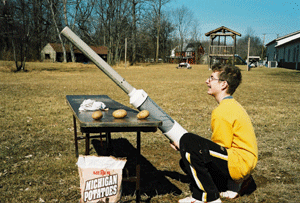
Explosion "potato cannon" demonstrated at Homeschool Science Day
|
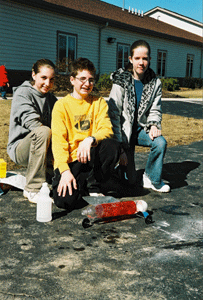
You don't need to buy fancy equipment to study science in the real world. Borrow expensive apparatus, such as telescopes and microscopes, from friends or family. If relatives usually purchase expensive gifts, ask if they'd consider giving an inexpensive science kit. In our homeschool, we've enjoyed using kits for constructing rocket cars (see the photo on the next page), creating slime, designing gadgets, exploring electronics, growing crystals, and raising sea monkeys (actually tiny shrimp). We've found fun new kits for around $10, and for $1 at garage sales. Check used science materials carefully for missing, damaged, or dangerous parts such as scalpels and acids. Also, science catalogs can help you find unusual gifts. Try surplus science and lab supplies through American Science and Surplus,
www.sciplus.com.
Adventurous families might enjoy using everyday materials and household discards to build science projects similar to our friend's potato cannon (see photo). Check the library for ideas on how to use everyday objects in science, such as the book Backyard Ballistics by William Gurstelle. This book uses diagrams, photographs, and text to provide step-by-step instructions for making thirteen ballistic devices, including a match-powered rocket and a Cincinnati fire kite. You can find free science project ideas from web sites, such as The Splorg Potato Cannon Project, www.ocf.berkeley.edu/~fricke/spudgun/. Tony's Spud Gun page, www.tommasi.org/spud/index.html (unavailable), provides plans, as well as a letter from BATF, describing legal issues involving spud guns.
We cannot guarantee the safety of any device that you build - only you can. We strongly urge adult supervision. If you'd like something more tame, build a marshmallow catapult or a balloon-powered rocket. Find free instructions at BOAST, www.tommasi.org/spud/index.html (unavailable).
Some public libraries loan out educational toys that demonstrate science concepts, as well as other subjects. If you live near a teacher's college, find out if you can borrow expensive equipment, such as science labs and software. In our area, a local college opens their teacher's library to any educator, including homeschoolers. You may need to show proof that you homeschool. We show the response that our local school district sends to our yearly letter of intent to homeschool.
Check out neighborhood parks for free science and nature programs. In some cases, a small equipment fee may be involved; it's still much cheaper than buying the equipment yourself. Find free information about wildflowers native to your area from your local state university extension agent, or at the Native Plant Information Center, www.wildflower2. org/index.html.
Consider free and inexpensive contests to put your child's science knowledge to the test. Any homeschool student in kindergarten through eighth grade can enter and win the local Invention Conventions. The homeschool inventors that go to the finals in May must live in a participating school district. (See www.just-think-inc.com for participating school districts.) The basic rules are:
- Think of a problem
- Invent an original solution.
|
|
A tamer possibility—the rocket car.
|
Network with other homeschoolers to find inexpensive science opportunities. Many homeschool groups offer science fairs. Locate homeschool groups online at
www.home-school.com/groups/. If the science fair awards medals or ribbons, you may need to pay a small additional fee. Homeschool support groups may also host science classes or science day activities.
If your child loves science, you can use science to encourage language arts skills. If you child enjoys science but dislikes history, learn about famous scientists. Discover scientific methods and laws through biographies of famous scientists. Put the scientists on a timeline, in context of other historical events. Now your kids are learning history, too!
We used a few second-hand science textbooks that interested our children in the early grades. Mostly, however, we emphasized topical nonfiction and fiction books on science. Although field guides can be expensive, we purchased them used or on sale over a period of many years. We visited the science section of the library, and let our children pick out the most intriguing materials. Our library carries books and movies such as Magic School Bus' Ready, Set, Dough. Magic School Bus demonstrates science principles through fun stories. You also might enjoy the Standard Deviants science videos, available at many public libraries.
Many church and pastoral libraries will loan out educational materials and books. You might locate science materials, such as It Couldn't Just Happen: Fascinating Facts about God's World, by Lawrence O. Richards, and Moody science video classics, such as City of the Bees.