How to Start a Music Co-op
By Rhonda Barfield
Printed in Practical Homeschooling #45, 2002.
 Lessons for all your kids in strings, orchestra, keyboard, guitar, and choir, for $20 per kid per semester. And it only takes one day a week. How does the Northwest County Homeschool Music Co-Op do it?

|
 |
 It's a typical Thursday morning for our homeschooled family. At precisely 8:10 a.m., my four children and I are waiting in our minivan on an empty parking lot of a church in suburban St. Louis County, Missouri. Eric, 15, begins unloading his keyboard and synth module. Christian, 13, grabs a bag with Math-U-See and a notebook, and the girls, Lisa, 12, and Mary, 10, gather their violins and music folders. I am in charge of the choir accompanist's notebook and, equally important, a football and two basketballs.
Soon the church secretary unlocks the back door. Mothers with children of all ages straggle into the church. Within an hour, other families begin to arrive. Chatham Bible Church will soon house nearly 170 homeschooled students plus teachers, assistants, parents, and younger siblings.
For now, it's still relatively quiet. In one classroom, an orchestra is setting up chairs and tuning instruments. Eric goes to the church gym and assembles his keyboard gear. Christian shoots a few hoops with friends before settling into a comfortable corner of an upstairs lounge where he can work on math. Lisa and Mary, part of a beginning strings class, join six other children who are learning to play violin. I take a stroll to the main entrance and check out the bulletin board that features today's hand-written announcements.
It's another business-as-usual weekly meeting of the Northwest County Home School Music Cooperative.
|
|
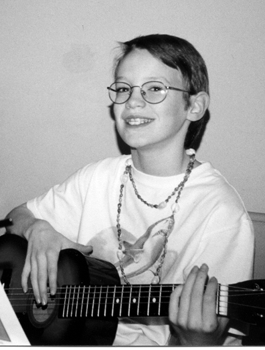
Beginning guitar class is fun!
|
Four Good Reasons to Co-Op
I've been involved with co-ops for ten years, but for our family, this particular one has provided the most satisfying experiences of them all. It is no ordinary cooperative, for at least four reasons.
First, as Terri Blackwell, director of the co-op notes, "We've put God first. We decided in the beginning that we were going to serve Him, to pray about everything, and to search His will for what we do." The co-op's mission statement is summarized in Psalm 118:23: "The Lord has done this, and it is marvelous in our eyes."
Second, the co-op is staffed entirely by volunteers, including the director, teachers and assistants, and no one receives direct pay. (This doesn't minimize the quality of instruction; it is surprisingly high.) All parents who enroll their children are expected to take an active role in helping out, from setting up chairs in classrooms to supervising toddlers to assisting teachers. Other jobs might include manning the information desk, singing along with the struggling tenors in choir, or helping to keep order in the beginning theory class.
Third, the co-op is designed to be very convenient to homeschoolers' schedules. Last year, I had checked out an excellent choir program in my suburb, but decided against it when I realized I would have had to drive 20 minutes one way to two separate weekly 90-minute practices for my four children. The Northwest county program, in contrast, offers classes for ages pre-K through high school simultaneously, all in one morning, plus babysitting. Homeschool parents can block out one three-hour period for all of their children, of all ages and abilities, and know that formal music instruction for the entire family is covered in a single day.
Finally, the co-op is hard to beat when it comes to cost. I was astonished to learn that a child can take up to four classes each Thursday for $20 total per semester. A few extra costs are involved, such as music books for some classes, a low church maintenance fee, and $10 per child for a 90-minute afternoon drama class. As an assistant teacher, I was charged half the going rate. Our family's total tab for the semester for four children's instruction, other fees, and the use of two violins, was $90 total.
|
|
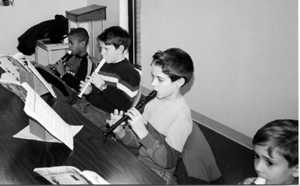
Beginning recorder class
|
Northwest County Homeschool Music Co-op has officially been in operation since the fall of 1994. That spring, several mothers made the decision to form their own band and choir rather than continue to participate in a homeschool group led by only two teachers. Terri Blackwell and friends envisioned a cooperative situation where several parents shared responsibilities. They also hoped to provide a ministry with costs held to an absolute minimum.
Over the course of seven years, the co-op has changed locations four times, now meeting and filling a majority of Chatham Bible Church's classrooms plus a gym, and, occasionally, the sanctuary. Each year, students produce two full-length concerts and two drama productions. The choirs, bands, and some individual players are involved in an annual, competitive, city-wide music contest. They also play and sing at a nearby nursing home twice a year.
Schedule of Classes
The current schedule is arranged as follows:
8:30 Beginning Strings. Lisa and Mary learn violin in this class. God's Glory Orchestra, the most advanced orchestra of the four offered.
9:30 Beginning Orchestra. Intermediate Orchestra. Advanced Orchestra. (Eric plays keyboard in the orchestra class.) Beginning Guitar. Intermediate Guitar. Beginning Keyboard. I assist in this class of young beginners with their electronic keyboards. Beginning Recorder. Advanced Recorder. Beginning Theory. One teacher, with several helpers, leads a class of four- and five-year-olds in lively games, songs and an introduction to music theory. Advanced Theory, including kindergartners and first graders, continues work on theory.
10:30 Devotional. All children break into two groups for a short age-appropriate devotional and prayer time. Older students produce their own highly creative presentations.
10:40 Beginning Choir. Intermediate Choir. (Mary is in this group.) Advanced Choir. Eric, Lisa and Christian sing while I accompany the choir of sixth through twelfth graders.
At 11:30, some members of the co-op go home for the day, but many meet at a designated fast-food restaurant for burgers and fellowship. My boys, being very sports-minded, stay at the church gym and/or parking lot, where there are ongoing, informal basketball and touch football games. My girls, in another corner of the gym, play games of Foursquare, Red Light, and Piggyback with other girls and younger boys.
1:00 brings, as Lisa puts it, my favorite class... drama. 32 children ranging from ages seven to seventeen are currently working on a series of twelve skits to be presented between music acts at the next concert.
At 2:30, when drama class officially dismisses, there's more time in the gym for those who want it. All of us, though tired from the intensity of the day, still find it difficult to leave. Many mothers and kids linger for a last snatch of conversation or a hoop to shoot or a pass to catch.
|
|
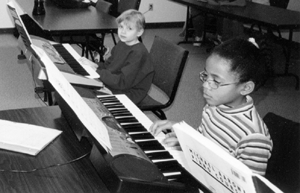
Beginning piano class
|
Prayer Helped Co-Op Thrive
While some co-ops struggle to fully involve even a few interested parents and children, the Northwest County Music Cooperative has reached maximum capacity and maintains a waiting list of 30. Some members, such as Peggy Capps, a mother of five children ages newborn to 16, drive as much as an hour and fifteen minutes one way in order to participate; Peggy leaves home every Thursday at 6:45 am. "When we started with the co-op nearly seven years ago," Peggy recalls, "we had only 20 plus kids. There are probably groups out there with more credentialed talent. But we stuck with this group mainly because they had more praying people. Every time they've gotten bigger, they've prayed. They pray about every decision."
When Terri Blackwell was diagnosed with cancer a few years ago, co-op members not only prayed but also pitched in to clean her house and provide meals for the family. Peggy Capps experienced a similar outpouring when her youngest child, Samuel, was born with half a heart. "There were people from co-op showing up at the hospital," Peggy says, "people I never expected." Because of this closeness among participants, the co-op has thrived.
Top Tips for Starting Your Own Music Co-Op
Members also look for ways to help and improve the overall musical experience. "Music itself is a shared gift," says Julie Burgess, director of the advanced choir and teacher of the beginning keyboard class. "It's so important that kids learn to work together toward the goal of a good presentation. I also like the fact that there are so many personalities - and parents with different skills - involved, so kids can learn from different people instead of just one person's way all the time."
Through several years of in-the-trenches experience, organizers of the cooperative have learned what works for them. Here are their recommendations for other homeschoolers who might consider forming their own co-op.
- Designate a parent committee as being in charge; avoid placing control in the hands of only one or two people. At this co-op, all parents are expected to be actively involved, fully in charge of their children, familiar with rules, and present at two parent meetings per semester.
- Recognize and use the talent within the group. One of the instructors in the co-op recently confided that she never earned a high school diploma. I would not have guessed, as she is an outstanding teacher. The co-op has encouraged such women's participation, based on dedication, willingness to try, and ability to work with children, rather than on degrees.
- Know what you want to accomplish and make sure it's in writing. Besides listing goals, the co-op has compiled a handbook to explain rules and procedures. In August, a meeting is held before school starts to carefully review the handbook and give parents a chance to provide input.
- Keep the hours limited. The first music co-op's set-up, with only two instructors, made it necessary for some families to stay for an entire day while all their children waited for instruction. By using several teachers, all music classes at the Northwest County co-op are completed within three hours.
- Communicate. Besides the required parent meetings, announcements are written weekly on a large bulletin board next to the front entrance. Nearby is a large box of file folders, one per family, where mothers can check for memos and other important notices. A directory lists phone numbers and e-mail addresses, plus directions on whom to call, and when, if a question arises; one woman is designated as the person to contact when members don't know who else to call!
The volunteers at this music co-op say that, given the chance to do it again, they would have changed a few procedures and/or implemented others sooner. "We had five years with no handbook and no rules," Terri Blackwell says, "and it was chaos. We put that handbook into practice and things changed immediately. We started to grow by leaps and bounds as soon as we had guidelines established."
|
|
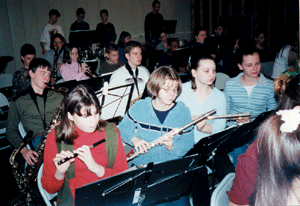
Advanced orchestra
|
Debbie Goldsmith, treasurer and teacher of the percussion class, agrees. "We have also learned to shift more responsibility to parents," she says. A couple of years ago, some women involved in a Bible study complained about students running through the church's halls after morning classes ended. "We didn't want to jeopardize our opportunity to stay at the church," Debbie notes, "so we decided, after the final class of the morning, to have the parents go directly to their children's classroom and pick them up. It made a 180-degree improvement with crowd control and other problems."
The co-op continually improves and expands its scope. Typical homeschoolers, the mothers (and a few dads) are creative in recognizing needs and filling them. In our keyboard class, for example, volunteers constructed music stands made of cardboard. Moms also organized a free clothing and shoe exchange to help families meet the dress code requirements of white shirts, black pants and skirts, and black shoes for performances.
Beyond members' best efforts, there is a sense that another Presence is in control and rewarding their efforts. "I could tell you so many stories," Debbie Goldsmith says, smiling. "Once, we had made arrangements to buy a clarinet from a music store. The store was supposed to put aside a certain clarinet for us to look at, one that cost $200 to $250. Terri and her sister went to check it out and the clerk couldn't find it anywhere. Instead, the clerk went to a rack with other instruments, where she pulled out a $450 clarinet and said she'd sell it for $200. This kind of experience, of God blessing us, has happened to us over and over again."
On another occasion, a co-op member's church owned a tympani with a broken mechanism that wasn't being used. Terri and Debbie talked the church into letting them repair the tympani, then use it for the co-op's orchestra until the church needed it again. "Chatham Bible Church had just freed up a space under the stairway where a discarded trash can had previously been stored," Debbie remembers, "so we put the tympani there for safe keeping. It's been two years, and the other church still hasn't asked for it back."
These are just a few of many blessings that God has poured out on the Northwest County Homeschool Cooperative. In return, the co-op greatly blesses those who participate. Speaking from personal experience, these Thursday morning classes have revitalized and energized my family's homeschool, and my children work harder on their other assignments so they'll be ready for music and drama. For the first time, we have been able to afford both private and group music lessons outside the home. Best of all, the co-op has added a dimension of richness and intensity to our lives without requiring huge time commitments.
Perhaps a similar music cooperative is a possibility in your area, for your homeschooling community. I would highly recommend the experience.