Mrs. Frohmee demonstrating proper handpainting techniques to Carsten |
When my friend Christina and I decided it was time to investigate homeschool cooperatives, the sheer number of support groups, cooperatives, and curricular programs available persuaded us we needed a plan to focus our search. Christina and I welcome the inspiration of group learning, but have no desire to sacrifice our individual educational ideals. We wondered how a homeschool parent would find a the best cooperative match amid concerns ranging from scheduling to curriculum. We set out to answer that question.
The cooperative Christina and I envisioned would allow parents and students to interact and share educational experiences, not necessarily introduce academic basics, but augment homeschool studies. We learned most coops charge monthly tuition, with extra fees for special activities. Tuition compares to the cost of enrolling in a music or karate class. Cooperatives may be entitled to take advantage of reduced rates for field trips to museums, theater or the zoo. We found local cooperatives via internet search, the state board of education, state homeschool association, community word-of-mouth, and public bulletins.
First, we narrowed our searches. We then investigated likely cooperatives, considering each coop's educational philosophy, religious affiliation, aesthetic compatibility, and procedures. Finally, we considered ways to redirect when our searches stalled.
Part I: Narrow the Search
We began our query of a prospective cooperative by reviewing its printed information-mission statement, member handbook, newsletter, and website. These materials list meeting and activity schedules, annual fees, and what those fees purchase. We considered parent and student responsibilities like fund raising, event planning, child care, and carpool.
We evaluated the age range the cooperative serves, and whether the co-op employs professional instructors or community and parent volunteers for learning activities. Joining a cooperative means adding another commitment to what may be an already hectic family schedule. When families consider a co-op which will serve multiple children, it helps to remember that it takes a skilled instructor to engage students across a broad age range.
We then requested visits to appealing co-ops. Co-op visitors may observe the cooperative's atmosphere, how the students and adults engage with each other, and the instructional style.

Aaron and Abby with the class aquarium |
Tanya is a mother of four, living in Northern Idaho. When she began homeschooling her children, she found her small town was home to only one cooperative. Tanya noted that, "Everybody in the co-op has a different motivation. But homeschooling is the common tie."
After visiting the co-op, Tanya elected not to take part in the group's weekly instructional sessions. But her family was still welcomed for social events and included in the co-op's annual scrapbook.
Part II: Investigation
Visits to the co-op's meeting space and interviews with cooperative directors are essential. Initiating contact with a phone call can provide encouraging results.
Ten years after her first co-op experience, Oregon resident Janet still remembers her initial conversation with the director of the Portland-based Oregon Home Education Network. On the phone, Janet could hear the director's youngsters working.
Janet asked what project the children were engaged in. They were embalming a chicken. "Needless to say, I was impressed," Janet says.
Define Educational Philosophies

Abby reading her picture book |
Christina and I deem an interview with the director as essential to understanding the cooperative's educational philosophy. Our educational philosophies are the sum of our expectations about the way students acquire knowledge and skills.
Our preferences about classroom environments offer clues to our educational philosophies. Cooperative members may not use the terms "classical" or "emergent." Christina and I gauge a co-op's philosophy by its instructional format and the models to which co-ops compare themselves.
Envision a classroom wherein students sit in rows, reading from copies of the same text, while a teacher stands at the head of the class; the room is quiet but for the sound of the teacher's voice, and the whispered motion of a student raising his or her hand.
Now picture a classroom in which students are randomly dispersed at tables, near the chalk board, on the floor in beanbag chairs, while students read or write individually or discuss diverse topics in small groups; the teacher is seated on the floor near a student.
Which imaginary classroom seems inviting? If it's the group of students with teacher front and center, your philosophical pendulum swings toward a classical philosophy. If you prefer to imagine students simultaneously pursuing divergent tasks, your pendulum swings toward an emergent approach.
Classical education can be defined as teacher-centered, based on the principle that external structures assist student learning. Students of Plato and Socrates engaged in classical learning, studying printed and verbally transmitted lessons. In the classical Waldorf model, students are exposed to an integrated and diverse curriculum that follows a predetermined order, timeframe, and range prescribed by child development and education research.
Emergent education can be defined as student-centered. Student interest, progress, and aptitude inform the teacher how and when to present curricular content. Montessori teachers, for example, model work with a prepared set of instructional tools, then allow students to explore and master skills at their own pace. The Reggio Emilia approach requires that teachers continually modify their instructional techniques to meet the needs of the current student body. Sudbury schools provide students access to whatever tools they require to both instruct themselves and negotiate the governance of the school.
Student rewards and discipline can indicate a co-op's educational philosophy. The interview process can reveal whether achievement markers are built into the co-op's curriculum, or students set their own standards and rewards-if board members consider student input when outlining and enforcing disciplinary recommendations.
Each home educator and child rides a pendulum which rests somewhere between classical and emergent instruction.
Acknowledge Religious Preferences
Renee, director of a Christian cooperative in Washington state, recalls feeling awkward when a parent asked permission to teach Buddhist practice to cooperative students. In spite of her discomfort, Renee was obliged to remind the parent of her signed contract limiting religious instruction within their co-op to the Protestant Christian tradition.
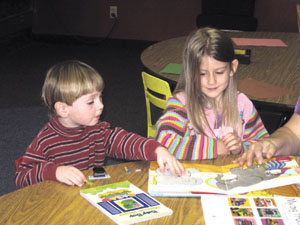
Carsten and Abby at the reading table |
Families may work effectively with a co-op that does not mirror their chosen religious practice, but dogma and doctrine do influence curriculum and activity selections. Topics with religious or spiritual overtones span natural and social sciences, literature and the arts. Christina and I learned to respectfully ask about a cooperative's stand on issues like evolution, homosexuality, and fantasy literature.
Consider Aesthetics
Christina and I also believe it's important for students to share some aesthetic preferences with their cooperative peers.
We ask if other co-op members listen to pop music and attend live concerts. Do they go to the cinema, watch videos and television? Do they attend live theater? Do the older students have jobs, plan to attend college or trade school?
Observe Procedures
When it is not possible to attend a cooperative board meeting, Christina and I request a sample of the board's minutes. We check that board members fill logical, standard roles, such as secretary and treasurer. We also look for formal proposal and voting procedures, since accountability fosters a sense of trust, especially when money is changing hands.
We ask if the meeting site and employees are insured. We enquire about the application process for instructors and for any supervisor with whom we may be expected to leave our children.
Part III: Redirection
Our research revealed some limitations. First, Christina and I met with resistance to investigating a co-op during the spring and summer. We found it more efficient to consult cooperative coordinators September through November and January through April.
Second, many homeschooling parents are reluctant to instruct any children but their own. Families seeking academic stimulation may need to join a larger cooperative association.
Michelle homeschools her children on their farm in Minnesota. She prefers an instructionally based cooperative experience. "Kids inspire other kids," Michelle says.
When Michelle offered to trade instructional time with local homeschool parents, they declined, saying they do not know anything worth teaching or do not have the time. Instead of an intimate local co-op, Michelle invests in field trips and conferences sponsored by her statewide homeschool association.
Part IV: Learning Opportunities
Initiating a cooperative investigation with a plan will help families find the enrichment of a learning community without compromising their educational goals. Establishing our plan helped Christina and me to approach the search with confidence. That confidence helped us remain patient and professional when our research stalled or took an unexpected turn.
Again, Christina and I first narrowed the search with a review of printed information and a site visit. Our interviews evaluated each co-op's (1) educational philosophy, (2) religious affiliation, (3) aesthetic compatibility, and (4) procedural accountability.
The right cooperative membership augments the homeschooler's learning. The research and interviews Christina and I conducted reminded us of the varied ways in which families learn together. We were stimulated by the process of reviewing our educational philosophies and aesthetic expectations.
Not surprisingly, Christina and I found that the search for a cooperative community is a learning opportunity in itself.